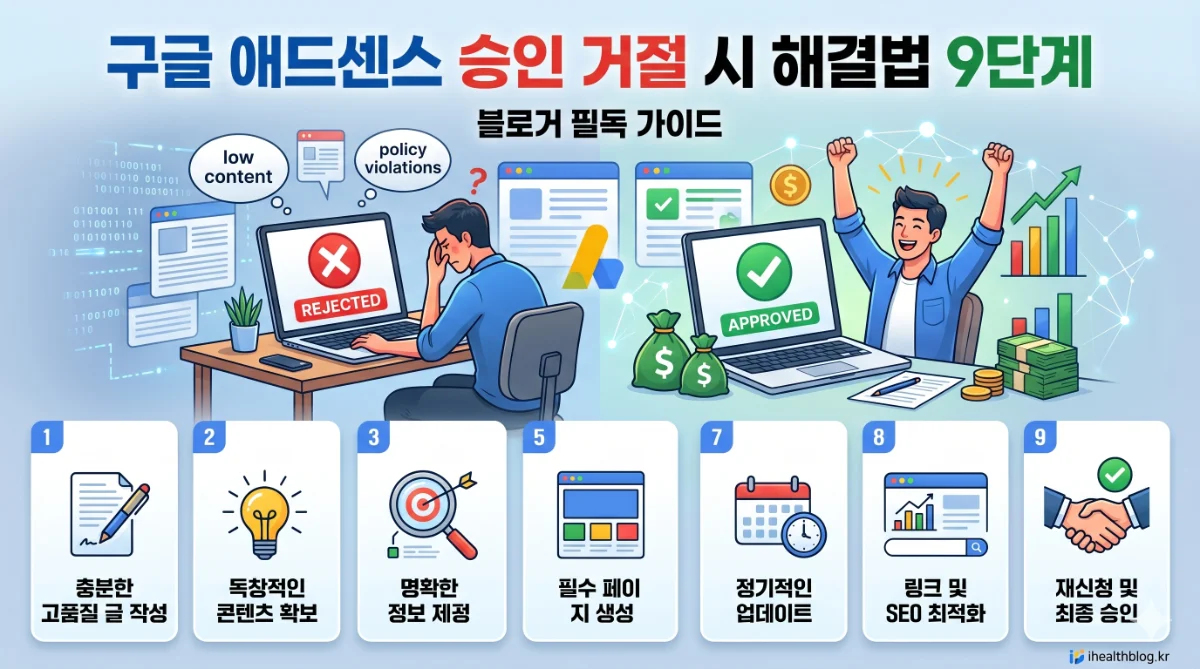
Google AdSense Approval Denied, Why Does It Keep Getting Rejected?
After a few months of blogging, you've finally reached 100,000 monthly views, but your Google AdSense approval keeps getting denied? As of 2024, the approval criteria for Google AdSense have become even stricter. This is one of the most common issues faced by Korean bloggers.
According to statistics, the approval rate for the first AdSense application is around 30-40%. In particular, Korean bloggers experience a higher rejection rate compared to English-speaking bloggers, which is due to issues with content quality, user experience, and policy compliance. In this article, we will introduce a 9-step solution to get your AdSense approval.
Step 1: Check Basic Blog Settings
The AdSense review checks whether your blog meets the basic website requirements.
- Domain Ownership Verification: Are you using a custom domain (e.g., myblog.com)? Free blog platforms (like Tistory subdomains) have a lower approval probability.
- HTTPS Security Settings: A must-have for modern websites. Make sure HTTPS is enabled in your blog settings.
- Mobile Optimization: As of 2024, mobile traffic accounts for about 75-80% of total traffic. Responsive design is essential.
- Loading Speed: Aim for a minimum of 50 points on mobile in Google PageSpeed Insights.
Tip: Submit your sitemap to Google Search Console and check if all pages are indexed properly. A high number of unindexed pages can reduce your credibility.
Step 2: Secure More Than 5 High-Quality Content Pieces
The AdSense review team evaluates whether your content is original and valuable. As of 2024, Google is very strict about AI-generated content and low-quality content.
- Minimum Word Count: At least 1,500-2,000 words of original content per post
- Depth of Topic: Analytical articles that include insights and data rather than superficial information
- Visual Materials: Include photos you’ve taken or images from legitimate sources (be mindful of copyright)
- Regular Uploads: Maintain a consistent posting frequency of about 3-4 times a week
Especially if you are covering health, medical, or financial topics (YMYL: Your Money Your Life), reliable sources and evidence are essential. For example, it’s advisable to cite materials from the Korean Medical Association or the Ministry of Food and Drug Safety for health information.
Step 3: Create Essential Pages
Google AdSense values the transparency and credibility of websites. The following pages are mandatory:
- About Us: Clearly state the identity of the blog owner and the purpose of the blog (more than 200 characters)
- Privacy Policy: A legal document, use tools like Google’s policy generator or services like iubenda
- Contact Us: Must include an email address or a contact form
- Disclaimer: Essential if you have YMYL content ("The information on this blog is not professional medical advice")
- Cookie Policy: Guidance on cookie usage considering EU GDPR, etc.
These pages must be explicitly linked in the footer and accessible from all pages.
Step 4: Remove Policy Violating Content
Violating Google AdSense policies is the most common reason for rejection. As of 2024, pay special attention to the following:
- Copyright Infringement: Unauthorized use of others' photos, writings, or videos. Use legitimate sources (Unsplash, Pexels, Pixabay)
- Clickbait Titles: Exaggerated titles that are unrelated to the actual content
- Violent/Hate Content: Includes political extremism, discrimination, and hate speech
- Drug/Illegal Substance Related: Information on how to use or sell drugs
- Adult Content: Explicit adult material or pornography
- Unapproved Medical Claims: Claims like "cures cancer" without medical basis
- Gambling/Illegal Gaming: Links or promotions for gambling sites
Self-Assessment Method: Read through all the content on your blog from the perspective of a first-time visitor. Ask yourself, "Is this information trustworthy?"
Step 5: Optimize for SEO to Secure Organic Traffic
Google trusts sites with an average of over 10,000 monthly views of organic traffic. They prioritize organic traffic from search engines over simple visitor counts.
- Keyword Research: Use Naver Keyword Tool and Google Search Console to check actual search demand
- Meta Descriptions and Title Tags: Write SEO-optimized titles and descriptions for each post
- Internal Linking: Connect related posts to increase user dwell time
- External Backlinks: Reference links from trustworthy sites (guest posting, news articles, etc.)
If you're a Korean blogger, consider Naver Blog and Naver News Partnership. This can help you secure initial traffic and then shift that traffic to your custom domain as a strategy.
Step 6: Improve User Experience (UX)
You must meet the evaluation criteria for Google’s Core Web Vitals in 2024:
- LCP (Largest Contentful Paint): Page loading time within 2.5 seconds
- FID (First Input Delay): User input response time within 100ms
- CLS (Cumulative Layout Shift): Minimize unexpected layout shifts (score below 0.1)
Actual improvement methods:
- Image Optimization: Use WebP format and resize to necessary dimensions
- Plugin Cleanup: Disable unnecessary plugins to improve loading speed
- Limit Ad Placement: Excessive AdSense ad code insertion can slow down loading speed
- Set Up Caching: Use tools like Cloudflare or WP Super Cache
Step 7: Familiarize Yourself with AdSense Policies and Make Minor Adjustments
Many bloggers apply without properly reading the policies. Accurately identify the policy violations mentioned in the rejection email.
- Re-read Policy Documents: Review all sections of the Google AdSense Policy Center
- Check robots.txt: Ensure Google crawlers can access all pages
- Install Google Analytics: Transparently sharing traffic statistics increases credibility
- Link Google Search Console: Submit search performance data
Important: If the rejection email specifies particular reasons, make clear improvements in those areas before reapplying. Repeated issues can lead to permanent restrictions.
Step 8: Final Checklist Before Reapplying
Before reapplying, check the following items:
- □ Blog has been running for over 3 months, with more than 30 posts
- □ Monthly organic traffic exceeds 10,000 (check Google Analytics)
- □ All pages have HTTPS applied
- □ About, Privacy Policy, and Contact pages are complete
- □ No copyright infringement content
- □ No adult or gambling-related content
- □ Each post has more than 1,500 words of original content
- □ At least 3 post updates in the last 30 days
- □ Confirm it displays correctly on mobile devices
- □ Page loading speed in the 2-second range (Google PageSpeed)
If all these items are met, the success rate for reapplication rises to about 70-80%.
Step 9: Alternative Monetization Strategies After Rejection
If your AdSense approval is delayed, consider pursuing other monetization methods:
- Coupang Partners: The most accessible affiliate marketing platform in Korea. Relaxed membership conditions
- Naver AdPost: Available if you have more than 1,000 views per month. Tailored for Korean bloggers
- Google AdManager: Allows direct ad sales with lower criteria than AdSense
- Mediavine, AdThrive: Requires over 25,000 monthly views, but offers higher CPM than AdSense
- Amazon Associates: Earn about 3-8% commission by recommending Amazon products
Especially Coupang Partners has low membership criteria (immediate approval if specific conditions are met), allowing you to generate an additional income of 300,000 to 1,000,000 KRW during the AdSense waiting period.
Conclusion
Getting Google AdSense approval is not just about "applying and waiting". It requires a systematic 9-step process:
- Basic Settings: Domain, HTTPS, mobile optimization
- High-Quality Content: More than 5 pieces of original content over 1,500 words
- Essential Pages: About, Privacy, Contact, Disclaimer
- Policy Compliance: Remove copyright, clickbait, and hate content
- SEO Optimization: Secure over 10,000 monthly organic traffic
- UX Improvement: Loading speed within 2.5 seconds, mobile responsiveness
- Policy Familiarization: Complete understanding of Google AdSense policies
- Final Check: Verify all items before reapplying
- Prepare Alternatives: Pursue other monetization methods while waiting for approval
As of 2024, AdSense reviews have become more stringent, but blogs that are run with care will eventually get approved. Focus on long-term stable revenue generation rather than quick approval, and you will find that bloggers who put in an average of 3-6 months of effort tend to maintain their AdSense accounts the longest.
If you are still facing difficulties, asking questions in the AdSense help forum in Korean or sharing experiences in blogging communities (e.g., blogger cafes, online forums) can also be a good method. Your blog can certainly succeed!