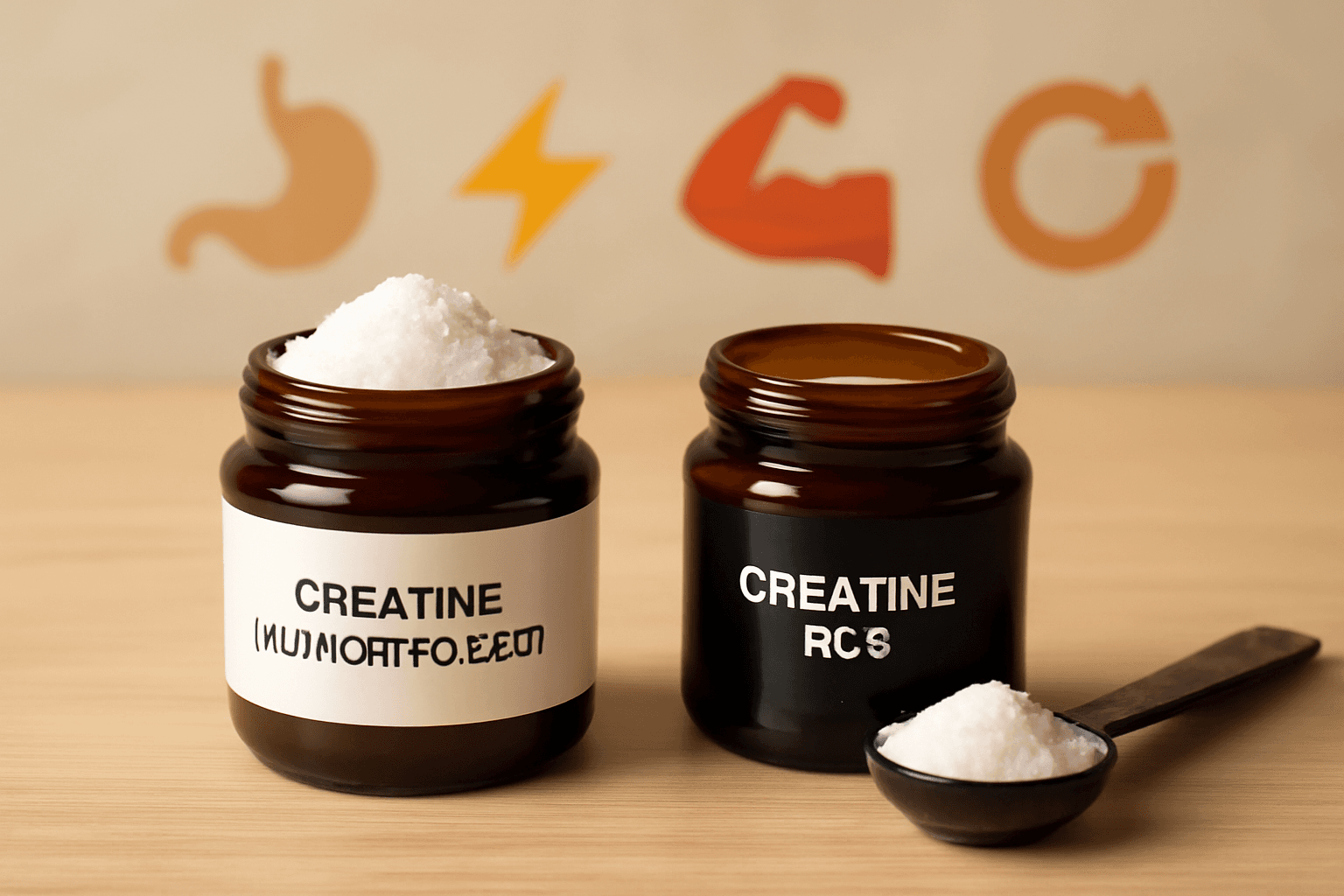
Creatine supplementation is one of the most extensively researched and widely used ingredients for enhancing athletic performance and muscle growth. However, the market offers various forms of creatine, with creatine HCL (hydrochloride) and creatine monohydrate being the two most popular options. These two forms differ considerably in terms of absorption rate, dosage, and side effects, and which one you choose depends on your individual goals and body type. In this post, we'll compare and analyze the characteristics of each form to help you select the creatine that's best suited for you.
What is Creatine?
Creatine is a derivative of amino acids naturally produced by the body, primarily in the liver, kidneys, and pancreas. More than 95% of the body's creatine is stored in muscle tissue, where it plays a role in supplying energy during muscle contractions. In particular, it promotes the resynthesis of ATP (adenosine triphosphate), enabling rapid energy replenishment in muscles.
Generally, adults consume about 1-2g of creatine daily through food (mainly meat and fish), but this is very small compared to the body's total storage capacity (approximately 120-140g). Therefore, athletes and fitness enthusiasts seeking to maximize exercise performance increase muscle creatine concentration through supplementation. Decades of research have proven that creatine supplementation is effective in improving high-intensity exercise performance, increasing muscle mass, and improving recovery speed.
Various Types of Creatine
The creatine supplementation market has grown rapidly over the past decade, with more than 10 different forms of creatine now available for purchase. Each form has undergone various chemical modifications to enhance absorption rate, stability, and solubility.
- Creatine Monohydrate: The oldest and most widely used form, with decades of research confirming its effectiveness.
- Creatine HCL (Creatine Hydrochloride): A form bound with hydrochloride, claiming better absorption and effectiveness at lower doses.
- Creatine Ethyl Ester: Developed to increase fat solubility, but with limited actual effectiveness.
- Creatine Alkaline (Kre-Alkalyn): A buffered form with a higher pH level.
- Creatine Malate and Tartrate: Combined with other compounds to improve solubility.
Among these various forms, creatine HCL and creatine monohydrate are the most popular due to scientific evidence and practical effectiveness.
What is Creatine HCL?
Creatine HCL is a form of creatine molecule bonded with hydrochloric acid (HCl). This chemical bonding method is designed to improve creatine's solubility and bioavailability. Generally, creatine HCL has approximately 38% greater solubility than creatine monohydrate, which means smaller particle size and faster absorption.
One of the main advantages of creatine HCL is that you can see results at lower doses. In most studies, creatine HCL users report that about 1.5-2g per day is sufficient, while creatine monohydrate requires 3-5g daily. This can reduce gastrointestinal discomfort and lower overall supplementation costs.
Additionally, there are claims that creatine HCL doesn't require a loading phase (taking 15-20g daily divided over the first 5-7 days). This means that due to high solubility, your body reaches optimal creatine levels more quickly. However, consuming sufficient water remains important. Some users report that creatine HCL is gentler on the stomach, but this varies significantly from person to person.
What is Creatine Monohydrate?
Creatine monohydrate is a form of creatine molecule bonded with one water molecule. This is the form that has been most extensively researched and used since 1992, with hundreds of scientific papers documenting its effects on increased muscle mass, improved exercise performance, and enhanced brain function.
The biggest advantage of creatine monohydrate is its cost-effectiveness. It provides equivalent effects while being significantly cheaper than other forms. For example, a high-quality 500g of creatine monohydrate typically costs between 10,000-15,000 won, while the same amount of creatine HCL costs 25,000-35,000 won.
The standard dosage is divided into a loading phase (5g four times daily for the first 5-7 days, totaling 20g) and a maintenance phase (3-5g daily). Maximum effects can be seen after approximately 3-4 weeks with this protocol. Even without a loading phase, consistently taking 3g daily will reach equivalent results after 4-6 weeks. The most common side effect of creatine monohydrate is slight water retention (1-2kg weight gain), which is due to water accumulation in the muscles and doesn't pose a health concern.
Key Differences Between Creatine HCL and Creatine Monohydrate
Absorption and Bioavailability
Creatine HCL shows faster absorption due to higher solubility (approximately 38 times greater). This means it is absorbed more efficiently in the intestines and reaches muscles more quickly. In contrast, creatine monohydrate has a relatively slower absorption rate, but with long-term use, the cumulative effects are equivalent.
Required Dosage
Creatine HCL: 1.5-2g per day (loading unnecessary, effects appear within 2-3 weeks) Creatine Monohydrate: 3-5g per day (5-7 day loading phase recommended, maximum effects within 3-4 weeks) Since a lower dose is required, creatine HCL may place less burden on the digestive system.
Cost-Effectiveness
Creatine monohydrate is significantly cheaper, allowing longer use for the same amount of money. Based on 3 months of use, creatine HCL costs approximately 150,000 won, while creatine monohydrate costs about 50,000 won.
Scientific Evidence
Creatine monohydrate is supported by more than 30 years of extensive clinical research. In 2017, the International Society of Sports Nutrition identified creatine monohydrate as one of the most effective supplements for enhancing exercise performance. Creatine HCL is a relatively newer form, and direct comparative research is limited.
Side Effects and Safety
Both are generally safe, with minimal side effects in adults with normal kidney and liver function. However, creatine monohydrate can cause abdominal bloating or diarrhea in some users, while creatine HCL is reported to have fewer such side effects.
Water Retention and Weight Gain
Creatine monohydrate can cause initial 1-2kg weight gain due to water accumulation in muscles. Creatine HCL may have less water retention due to higher solubility. However, this is not fat gain but water in muscles, which is positive in terms of body composition.
Which Creatine Should You Choose?
When Creatine HCL is the Better Choice
When you want faster results: With HCL's high solubility and rapid absorption, you can notice effects within 2-3 weeks.
When you have gastrointestinal sensitivity: The low dose (1.5-2g) is sufficient, so bloating and digestive issues are minimized.
When you want to minimize weight gain: With less water retention, you can focus more on pure muscle mass gains.
When convenience is a priority: No loading phase is necessary and you need to consume smaller amounts.
When Creatine Monohydrate is the Better Choice
When cost-effectiveness is your top priority: You can achieve proven effects at the lowest price.
When you want long-term safety: There are more than 30 years of research and millions of users' experiences.
When you need medical professional consultation: More medical literature and safety data are available.
When you're a beginner: Standardized loading protocols and clear usage instructions help minimize mistakes.
Medical Caution: Before starting creatine supplementation, please consult with a healthcare professional, especially if you have a history of kidney disease, diabetes, high blood pressure, or are currently taking medications. Since creatine is excreted through the kidneys, kidney health monitoring may be necessary.
Practical Usage Tips
How to Use Creatine HCL
- Take 1.5-2g daily with meals (promotes absorption)
- Loading phase can be skipped, effects expected after 2-3 weeks
- Consume adequate water (2-3L or more per day)
- Taking with high-carbohydrate meals enhances absorption
How to Use Creatine Monohydrate
- Loading method: Take 5g four times daily for 5-7 days (total 20g), then maintain at 3-5g daily
- Gradual method: Take 3g daily for 4-6 weeks without loading (slower but equivalent effects)
- Take with glucose-containing beverages or fruit (insulin response enhances absorption)
- Adequate water intake is essential (minimum 2.5L per day)
- Consistent intake is important (effects accumulate, so don't skip doses)
Summary
Both creatine HCL and creatine monohydrate are effective for muscle growth, improved exercise performance, and energy recovery. The key to choosing comes down to your individual priorities.
Choose Creatine HCL: When fast results, low dosage, digestive stability, and minimal water retention are important.
Choose Creatine Monohydrate: When value for money, proven safety, clear usage instructions, and long-term reliability are priorities.
Regardless of which form you choose, consistent intake for at least 4-6 weeks is essential, and it's difficult to expect results without regular exercise and proper nutrition. Also, don't forget to consume 2.5L or more of water per day and monitor kidney function. Depending on your health status, it's wise to consult with a healthcare professional before starting supplementation.