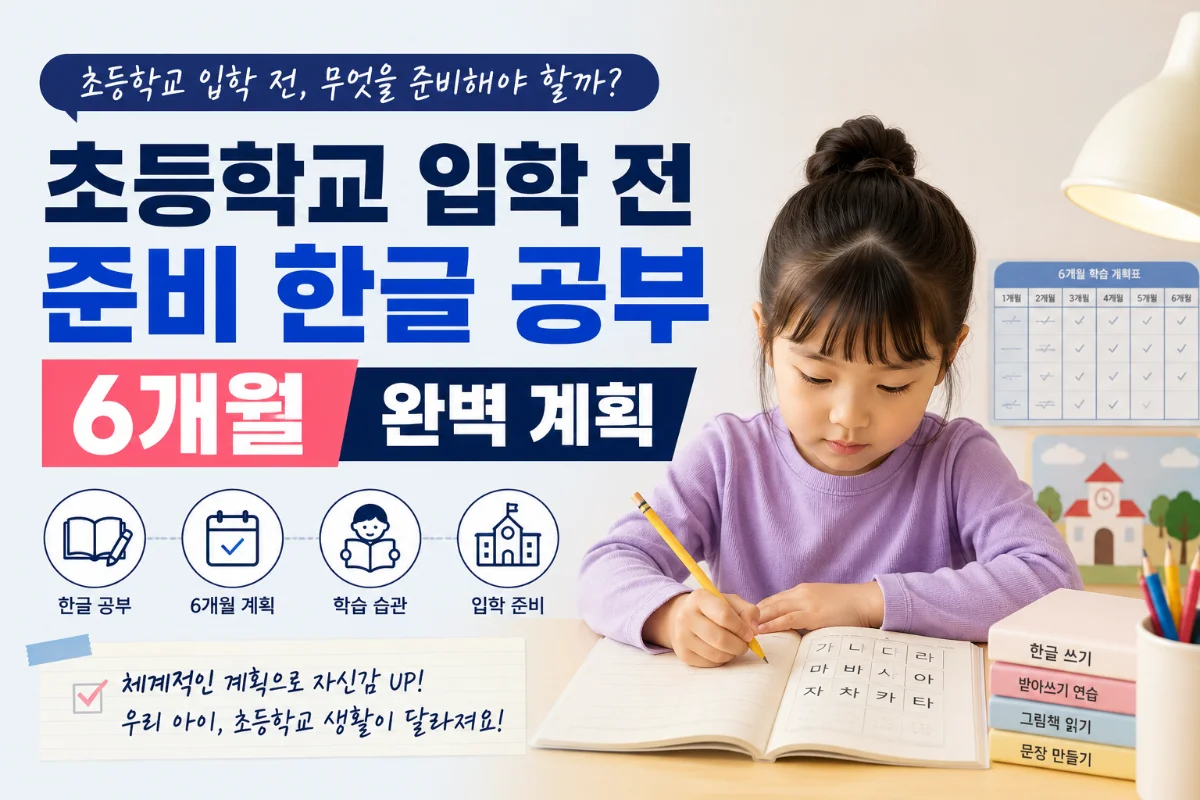
Preparing for Elementary School: Why is Studying Hangul Important?
According to the 2024 Ministry of Education statistics, about 65% of first graders have not fully mastered Hangul before entering school. This becomes a major factor causing learning gaps during the school adaptation process. A systematic study of Hangul for six months before entering elementary school goes beyond simple advanced learning and becomes a confident first step into school life.
Experts in Hangul education emphasize that ages 5 to 6 are the golden time for language acquisition. The speed of brain development during this period is the fastest in a lifetime, especially in terms of letter recognition abilities. Therefore, the six months before entering school is a period for optimal learning efficiency.
6-Month Hangul Study Roadmap: Step-by-Step Plan
Month 1: Basic Preparation Stage (Understanding Consonants and Vowels)
The first month is a time to understand the basic structure of Hangul. The goal is for children to grasp the concepts of consonants like "ㄱ, ㄴ, ㄷ" and vowels like "ㅏ, ㅑ, ㅓ".
- Main Study Time: 20-30 minutes a day, 5 times a week (total 100-150 minutes per week)
- Study Method: Fun approaches through card games, tracing with fingers, and coloring
- Recommended Materials: Hangul card set (about 8,000-15,000 won), sticker activity book (about 10,000-12,000 won)
- Practical Tip: If the child shows no interest, stop immediately and switch to another activity. Forcing the process can create resistance to Hangul.
During this time, the role of parents is to be a playful companion rather than a learner. Instead of asking, "What is a consonant?", ask, "What does this letter look like?" to encourage the child's initiative.
Months 2-3: Simple Syllable Reading (From Single Letters to Short Words)
In the second and third months, children combine consonants and vowels to create and read actual letters, starting with the most basic letters like "가, 나, 다".
- Main Study Time: 30-40 minutes a day, 5 times a week (total 150-200 minutes per week)
- Study Progress: Prioritize learning frequently used consonants (14) and vowels (10)
- Recommended Materials: Hangul wipe-off board (about 5,000-8,000 won), reading materials (monthly subscription basis about 20,000-30,000 won)
- Performance Measurement: If the child can read 5-10 new letters a week, that is considered normal progress.
"Parents should also feel the joy when their child reads their first letters. This positive experience at this moment determines the child's motivation for learning Hangul." - Child Language Development Expert
During this period, accumulating successful experiences is very important. Each time the child succeeds in reading, provide specific praise (e.g., "Great job! You combined 'ㄱ' and 'ㅏ' to make '가'!").
Months 4-5: Vocabulary Expansion (Understanding Short Sentences and Words)
The fourth and fifth months are stages where children read and understand words and short sentences beyond individual letters.
- Main Study Time: 40-50 minutes a day, 5 times a week (total 200-250 minutes per week)
- Study Content: At least 100 words related to daily life (mom, dad, milk, book, etc.)
- Recommended Materials: Picture word cards (about 15,000-25,000 won), reading materials for elementary preparation (monthly about 40,000-60,000 won)
- Activities: Ask simple questions about the sentences the child reads (e.g., "What did mom do?")
This is a time to build a foundation for reading comprehension alongside Hangul learning. The transition from letter recognition to understanding meaning begins.
Month 6: Final Preparations for School (Confident Reading and Writing)
The last month is the final check-up stage before entering school. Focus on reading while also practicing simple writing.
- Main Study Time: 40-50 minutes a day, 5-6 times a week
- Study Goals: Writing words related to the child, such as their name, school, and friends' names
- Recommended Materials: Dictation materials (about 12,000-18,000 won), letter writing notebook (about 8,000-10,000 won)
- School Preparation: Understanding simple classroom terms (Korean, math, break time, etc.)
5 Effective Learning Methods to Practice at Home
1. Finding Hangul in Daily Life Game
Explore letters together with your child in the supermarket, on the street, and at home. Celebrate every time your child discovers letters they can read on signs, product packaging, or books. This is an effective way to naturally integrate Hangul learning into play.
2. Interactive Reading Using Picture Books
Connecting meaning by reading the text of picture books together is more effective than simple letter learning. According to a 2024 study by the Korean Society for Child Education, interactive reading increases learning efficiency by 34% compared to general Hangul education.
- Choose a book selected by the child
- Let the child read parts they can
- Ask questions about the book's content and answer them
- Imagine being the main character of the book
3. Pre-Writing Activities to Strengthen Finger Muscles
Proper development of fine motor skills in the fingers is essential for writing Hangul. Along with reading, engage in the following activities:
- Coloring (3-4 times a week, 10-15 minutes each)
- Connecting dots
- Finding mazes
- Making clay
- Picking up small objects with chopsticks
4. Utilizing Play-Based Hangul Learning Apps
Limit screen time to 20-30 minutes a day, but well-designed educational apps can effectively motivate learning. Recommended apps (monthly subscription basis about 10,000-15,000 won):
- Hangul TtoTto (game-based letter learning)
- Hangul Ai (step-by-step progress)
- Smart Daily Hangul (daily learning tracking)
When using apps, parental co-learning is important. The process of parents confirming and praising what the child learns from the app increases learning effectiveness by more than three times.
5. Motivation Through Learning Progress Charts
Prepare a Hangul learning progress chart that can be attached to the wall (about 3,000-5,000 won). Let the child place stickers or color in the chart each time they achieve a goal. This visual sense of accomplishment enhances learning persistence.
Common Mistakes to Avoid in the Hangul Learning Process
Many parents make mistakes with good intentions:
- Excessive Learning Load: Concentrated learning for more than an hour a day can cause the child to resist. The principle should be short and frequent.
- Forced Learning: A coercive attitude of "You have to do it!" is less effective than a suggestion like "Let's try it together!"
- Comparing with Other Children: Saying "The kid next door has already read all the books" can undermine the child's confidence.
- Expecting Perfection: Mistakes in pronunciation or writing during the early stages of Hangul learning are a natural process.
- Ignoring Fun: The perception that it's play rather than learning is the most important.
Tips for Preparing for School in Connection with the School
In addition to studying Hangul, preparation for school adaptation is also necessary:
- Visiting the School: Visit the school before enrollment to show the classroom, restrooms, cafeteria, etc.
- Practicing Peer Relationships: Provide opportunities for interaction with peers separate from kindergarten or daycare.
- Establishing Basic Life Habits: Set a daily rhythm such as waking up at a set time and having regular meals.
- Fostering Independence: Strengthen self-help skills such as using the restroom, washing hands, and dressing.
Creating an Environment to Enhance Learning Effectiveness
The learning environment at home greatly affects the child's efficiency in studying Hangul:
- Dedicated Learning Space: Provide a desk and chair for the child (about 50,000-150,000 won). If they are too high or low, it can decrease concentration.
- Proper Lighting: A location with sunlight is good for eye health.
- Minimizing Visual Distractions: Choose a place where the TV and toys are not visible.
- Organizing Learning Supplies: Gather necessary tools (pencils, colored pencils, erasers, etc.) in one place.
Summary of Estimated Costs for 6 Months of Hangul Study
The average cost required for studying Hangul for six months before entering elementary school is as follows:
- Materials and Tools: About 100,000-200,000 won (cards, activity books, wipe-off boards, etc.)
- Subscription-Based Educational Services: 20,000-60,000 won per month × 6 months = about 120,000-360,000 won
- Learning Supplies and Furniture: About 50,000-150,000 won (desk, chair, other supplies)
- App Subscription or One-Time Payment: About 30,000-50,000 won
- Total Estimated Cost: About 300,000-760,000 won
However, it is not necessary to have everything. Sufficient learning can be achieved with picture books (available for free at public libraries) and everyday materials at home. Delay purchasing non-essential items and invest selectively according to your child's progress.
Conclusion
The six months of Hangul study before entering elementary school is not just about learning letters but laying a foundation for confident school life. From the basic understanding in the first month to practical application in the sixth month, it is most important to follow the step-by-step plan at the child's pace.
The key to remember is "naturally like play." Hangul learned joyfully will be remembered much longer than Hangul learned forcefully, and it will serve as motivation for the child's learning. Parents should act as playful companions rather than mere monitors of learning.
It is also important to acknowledge that each child develops at their own pace. Avoid comparing with other children and celebrate your child's small progress. Fostering a positive attitude towards learning will be the foundation for six years of learning in elementary school rather than achieving perfect Hangul skills before enrollment.
May the journey of studying Hangul be a joyful time for both parents and children. Celebrate small achievements together and welcome the new beginning of school!