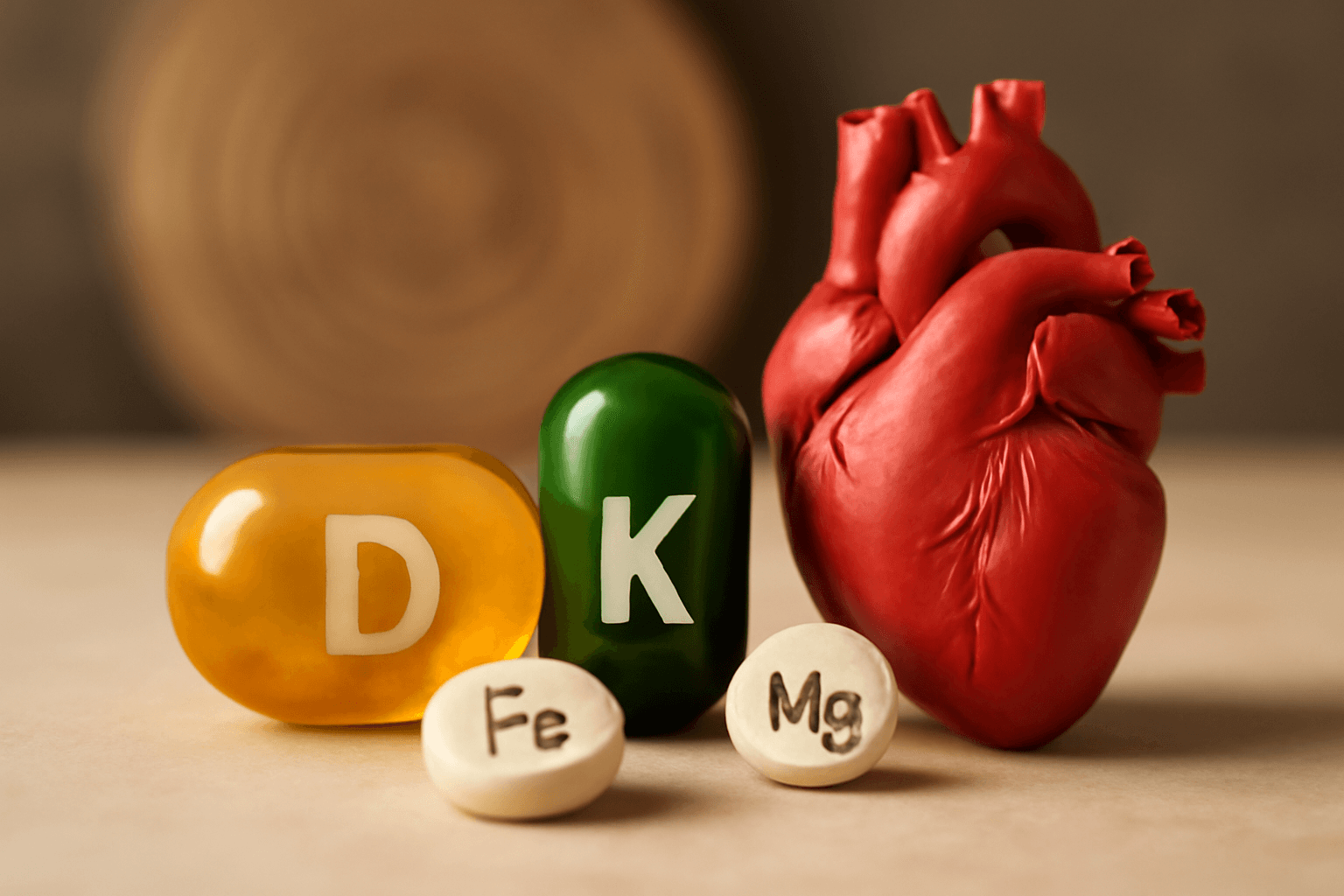
Cardiovascular health cannot be maintained by a single nutrient alone. In particular, vitamins D and K each play different roles—vitamin D in calcium absorption and vitamin K in blood clotting regulation—but when they work together, they produce synergistic effects including preventing vascular calcification, maintaining vascular elasticity, and improving cardiac function. When these nutrients work in conjunction with magnesium and iron, they enhance antioxidant effects and can effectively mitigate major risk factors for cardiovascular disease. In this article, we will examine in detail the individual roles of vitamins D and K, their collaborative relationship in cardiovascular health, and practical methods for obtaining adequate amounts.
What is Vitamin K?
Vitamin K is a fat-soluble vitamin that plays an essential role in protein synthesis and blood clotting in the body. Vitamin K is divided into two main forms: K1 (phylloquinone), which is found primarily in green leafy vegetables, and K2 (menaquinone), which can be found in fermented foods and animal products. From a cardiovascular health perspective, vitamin K2 is particularly noteworthy.
One of the most important roles of vitamin K2 is activating a protein called osteocalcin. This protein is essential for binding calcium to bone, while simultaneously preventing calcium accumulation in blood vessel walls. When this mechanism fails to function properly, calcium leaches from the bones and accumulates in blood vessels and soft tissues, leading to vascular calcification.
- Primary food sources of K1: Kale, broccoli, spinach, lettuce, parsley (approximately 145-1,062 micrograms per cup)
- Primary food sources of K2: Cheese, dairy butter, fermented foods (natto, kimchi), egg yolks
- Subtypes of K2: MK-4 (found in meat and eggs) and MK-7 (found in fermented foods); MK-7 remains in the body longer and provides stronger cardiovascular protection
According to research conducted in the Netherlands, people with high vitamin K2 intake had 52% less coronary artery calcification and 52% lower mortality from cardiovascular disease. This demonstrates vitamin K's ability to protect the blood vessel structure itself, going beyond simple blood clotting regulation.
What is Vitamin D?
Vitamin D is a fat-soluble vitamin that is synthesized by the skin upon sun exposure and can also be obtained through food. Once inside the body, vitamin D undergoes an activation process to function as a hormone called calcitriol. From a cardiovascular health perspective, vitamin D's role is highly multifaceted.
First, vitamin D promotes calcium absorption in the small intestine. Maintaining appropriate blood calcium levels is essential for normal muscle contraction, nerve transmission, and blood vessel function. Additionally, vitamin D regulates parathyroid hormone (PTH) secretion; when PTH levels are high, calcium is released from bones and the risk of its accumulation in blood vessels increases. Another important function of vitamin D is its anti-inflammatory action.
- Food sources of vitamin D: Salmon (3-4 micrograms per serving), mackerel (15 micrograms), egg yolks (0.8 micrograms), fortified milk (2.5 micrograms per cup)
- Sun exposure: Exposure to midday sunlight 3 times per week for 5-30 minutes each with arms and legs exposed can produce 50-80% of daily requirements
- Anti-inflammatory mechanism: Vitamin D regulates immune cell differentiation to suppress the production of inflammatory cytokines
In a meta-analysis published in the European Heart Journal in 2022, the group with the highest vitamin D levels (30-40 ng/mL or above) showed approximately 40% lower cardiovascular event risk compared to the group with the lowest levels (below 20 ng/mL). In particular, vitamin D improves vascular endothelial function to promote vasodilation and enhance blood circulation.
Cardiovascular Risk Factors
Cardiovascular disease is the leading cause of death worldwide. While various risk factors are known—including hypertension, high cholesterol, diabetes, obesity, smoking, and stress—recent research emphasizes that nutrient deficiencies are also important risk factors. In particular, deficiency in vitamins D and K directly promotes vascular calcification.
Vascular calcification is a form of atherosclerosis in which calcium accumulates in blood vessel walls, causing vessels to become stiff and lose elasticity. This leads to increased blood pressure, increased blood flow resistance, and increased risk of vessel rupture. Research on Korean populations confirmed that those with low vitamin K2 intake experienced faster progression of vascular calcification.
Furthermore, inflammation is a hidden risk factor for cardiovascular disease. People with high CRP (C-reactive protein) levels have up to three times higher cardiovascular disease risk than those with low levels. Vitamin D deficiency increases the secretion of inflammatory cytokines, worsening vascular inflammation. Magnesium deficiency causes stiffening of vascular smooth muscle, raising blood pressure, and iron imbalance increases oxidative stress.
Major cardiovascular risk factors: Vascular calcification, chronic inflammation, vascular endothelial dysfunction, vascular smooth muscle stiffness, oxidative stress, abnormal blood clotting
Synergistic Effects of Vitamins K and D
Vitamins K and D function independently but work together to maximize cardiovascular protection. The key to this synergy is maintaining calcium homeostasis.
Vitamin D promotes calcium absorption, while vitamin K ensures that calcium is properly fixed in the correct location (bone). If vitamin D is sufficient but K is deficient, calcium absorption increases but improperly utilized calcium may accumulate in blood vessels. Conversely, if vitamin K is sufficient but D is deficient, calcium absorption decreases and calcium released from bones may accumulate in blood vessels.
In the CAVOCADO study conducted by researchers at Maastricht University in the Netherlands, subjects with both high levels of vitamins K2 and D had the least coronary artery calcification, while those deficient in both had the most. Interestingly, the group high in K but low in D and the group high in D but low in K both showed intermediate levels of calcification, though the effects of dual nutrient deficiency were not equivalent. Vitamin K2 demonstrated a more powerful effect in preventing calcification.
Additionally, vitamins D and K together enhance antioxidant efficacy. Vitamin D promotes the production of anti-inflammatory cytokines, while vitamin K2 activates proteins that eliminate reactive oxygen species through protein carboxylation. Magnesium supports the absorption and activation of these two vitamins, while iron supports mitochondrial function to reduce oxidative stress.
- Vascular calcification inhibition: Vitamin K activates MGP (matrix Gla protein), vitamin D suppresses parathyroid hormone
- Endothelial function improvement: Vitamin D's anti-inflammatory effect + vitamin K's protein activation
- Blood pressure regulation: Vitamin D's regulation of the renin-angiotensin system + vitamin K's vascular smooth muscle stabilization
- Reduced thrombosis risk: Appropriate vitamin K levels maintain normal clotting while preventing excessive clotting
Recommended Intake of Vitamins D and K
Recommended vitamin D intake: The Korean Nutrition Society recommends a daily intake of 15 micrograms (600 IU) for adults. However, recent research recommends 20-30 micrograms (800-1,200 IU) to maintain optimal blood levels. During winter, in high-latitude regions, and for office workers, up to 50 micrograms (2,000 IU) can be consumed. For vitamin D supplements, D3 form is recommended over D2 form as it increases blood levels approximately 1.7 times more efficiently.
Recommended vitamin K intake: The Korean Nutrition Society recommends a daily intake of 65-80 micrograms for adults based on K1. However, for cardiovascular health, additional intake of K2 (menaquinone) is important. International research has shown cardiovascular protective effects at K2 intake levels ranging from 45-180 micrograms daily. If K2 intake through food is difficult, taking a menaquinone-7 (MK-7) supplement at 45-100 micrograms daily is effective.
Practical intake strategy:
- Breakfast: 2 eggs (vitamin K2, D) + 1 cup of fortified milk (vitamin D)
- Lunch: Grilled salmon (vitamin D) or grilled mackerel + kale salad (vitamin K1)
- Snack: 1 ounce of cheese (approximately 28 grams, approximately 50 micrograms K2)
- Dinner: Broccoli or spinach side dish (vitamin K1)
- Fermented foods: 1 package of natto (approximately 45 grams) or kimchi side dish for an additional 90-100 micrograms of K2
Supplement selection guide: It is convenient to purchase vitamin D3 and K2 (MK-7) together as a combination supplement. However, if you are taking anticoagulants such as warfarin, changes in vitamin K intake can interfere with medication effectiveness, so you must consult with a doctor. Additionally, excessive vitamin D intake (4,000 IU or more daily for extended periods) can increase blood calcium levels and raise the risk of kidney stones.
Role of magnesium and iron: To maximize the effects of vitamins D and K, adequate amounts of magnesium (320-420 mg daily) and iron (8-18 mg daily) must also be consumed. Magnesium is essential for vitamin D activation, and iron is essential for antioxidant enzyme synthesis. Magnesium is abundant in nuts, dark green vegetables, and whole grains, while iron is found in abundance in meat, oysters, and lentils.
Summary
Vitamin D and vitamin K are essential nutrients for cardiovascular health. Vitamin K, particularly K2, prevents vascular calcification and protects blood vessel structure, while vitamin D protects cardiovascular health through calcium absorption and anti-inflammatory action. When both nutrients work together, they produce synergistic effects including vascular calcification inhibition, improved vascular endothelial function, blood pressure regulation, and reduced thrombosis risk.
Obtaining sufficient amounts through food should be the first priority, but given modern lifestyles, taking supplements is also worth considering. A daily intake of 20-30 micrograms of vitamin D3 and 45-100 micrograms of vitamin K2 (MK-7) is recommended for most adults. Balance with other nutrients, including magnesium and iron, is also important.
However, if you are already taking anticoagulants or have kidney disease or calcium metabolism disorders, be sure to consult with a healthcare professional before beginning any new supplements. Cardiovascular health is built not through short-term efforts but through continuous improvement in lifestyle habits and appropriate nutrient intake.