The Importance of Recovery After Strength Training
After completing strength training, our muscles are in a state of micro-damage. At this point, proper recovery processes must be followed to increase strength and promote muscle growth. According to research by the Korean Society of Sports Science, those who used appropriate recovery methods after exercise experienced a 23% higher strength increase and a 35% reduction in muscle soreness.
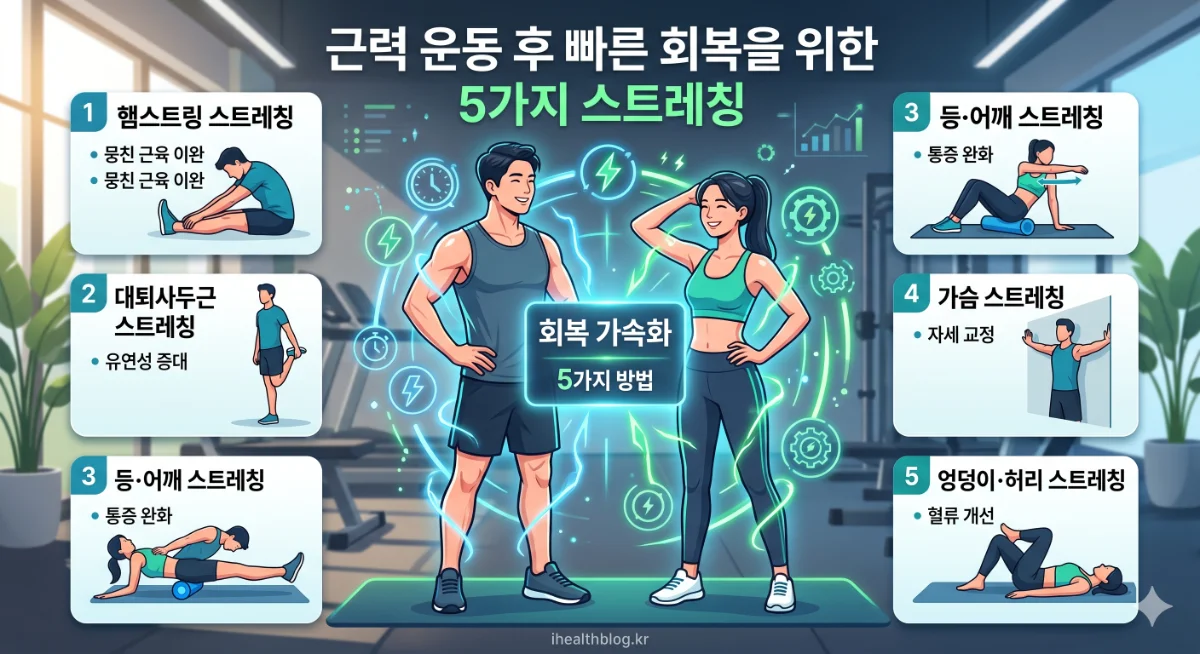
In particular, stretching is the simplest yet most effective method for recovery after strength training. It helps to relieve muscle tension, promotes blood circulation, and is excellent for relaxing stiff muscles after exercise. In this article, we will detail five scientifically proven stretching methods, their effects, and how to perform them correctly.
1. Static Stretching - A Must-Do After Strength Training
Static stretching is the most widely recommended method for recovery after strength training. It involves holding a position for 15 to 30 seconds while slowly elongating the muscles, and it is most effective when performed within 5 to 10 minutes after exercise.
Effects of Static Stretching
- Muscle Relaxation: Maintains muscles in a lengthened state of 15-30%, relieving tension.
- Improved Blood Circulation: Increases blood flow to the muscles, enhancing oxygen supply.
- Increased Flexibility: Regular practice can increase joint range of motion by an average of 8-12% per month.
Recommended Static Stretching Methods
Chest Stretch: Interlace your fingers behind your back and slowly raise your arms. Hold for 20 seconds until the chest muscles are sufficiently stretched, and repeat for 3 sets.
Hamstring Stretch: Sit with your legs extended and slowly bend your upper body to reach your toes without bouncing. Hold for 25 seconds. Perform 3 sets on each leg.
Quadriceps Stretch: Bend one leg and hold your heel to your buttock. Hold for 25-30 seconds and perform 3 sets on each leg.
Key Tip: Never use momentum during static stretching. Bouncing can cause muscle damage and reduce the effectiveness of stretching by 60%. The correct method is to slowly reach your maximum range of motion over 30 seconds.
2. Dynamic Stretching - A Choice for Active Recovery
Dynamic stretching involves gradually elongating the muscles through movement. It is most effective when performed about 10-15 minutes after exercise, and it has been shown to increase heart rate and improve blood flow faster than static stretching.
Advantages of Dynamic Stretching
- Increased Blood Flow: 15-20% more blood flow compared to static stretching.
- Nerve Activation: Stimulates the muscle nervous system, accelerating recovery speed.
- Maintaining Exercise Performance: Minimizes performance decline in the next workout session.
Recommended Dynamic Stretching Exercises
Leg Swings: Hold onto a wall or equipment with one hand and slowly swing one leg back and forth. Perform 10 repetitions, then alternate legs for 3 sets.
Arm Circles: Extend both arms and slowly make large circles from front to back. Perform 10 repetitions in each direction for 3 sets.
Torso Twists: Stand with your feet shoulder-width apart and cross your arms, slowly twisting your torso side to side. Repeat 15 times to the left and 15 times to the right for 3 sets.
3. PNF Stretching (Proprioceptive Neuromuscular Facilitation) - Advanced Technique Recommended by Experts
PNF stretching is an advanced technique that involves alternating contraction and relaxation, with research showing that it can improve flexibility by 25-30% more than regular stretching. It is particularly effective for recovering stiff muscles after strength training.
Principle of PNF Stretching
This method involves holding a stretch for 6 seconds while performing an isometric contraction (applying force without changing muscle length), followed by relaxing and stretching deeper. This utilizes the reflex actions of the nervous system to inhibit the muscle's stretch reflex, allowing for deeper stretching.
How to Perform PNF Stretching
Hamstring PNF Stretch:
- Step 1: Raise your leg to a 90-degree angle.
- Step 2: Support your leg with your hands or a towel while performing 20 seconds of static stretching.
- Step 3: Press your leg down while performing an isometric contraction for 6 seconds (applying force against resistance).
- Step 4: After relaxing, stretch deeper for 30 seconds.
- Repeat: Perform 3 sets on each leg.
Precautions: Due to its high intensity, it is safest to perform PNF stretching at least 30 minutes after strength training. Beginners are advised to start under the guidance of a professional trainer.
4. Self-Myofascial Release Using a Foam Roller
A foam roller is a recovery tool that can be purchased for between 50,000 to 150,000 KRW, and it can reduce recovery time by 40% by relieving tension in the fascia that surrounds the muscles.
Scientific Basis for Foam Roller Use
The fascia is connective tissue that envelops the entire muscle, and it can become stiff after exercise, hindering muscle growth. Using a foam roller helps to eliminate fascial adhesions and increase blood flow. According to research from Yonsei University's Department of Sports Science, using a foam roller for 10 minutes after exercise resulted in a 28% reduction in muscle soreness and shortened recovery time by 1-2 days.
Proper Foam Roller Techniques
Thigh Rolling: Place one leg on the foam roller, lift your hips to apply your body weight, and slowly roll from your knee towards your hip. Pause for 15 seconds on painful areas to apply deep pressure. Perform for 2 minutes on each leg.
Upper Back Rolling: Lie on the foam roller placed under your back, and slowly roll from the base of your neck to the upper back while pushing with your arms. Be careful to support your head with your fingers. Continue for 2 minutes.
Calf Rolling: Place one calf on the foam roller and adjust your weight with your hands on the floor while rolling. Perform for 1.5 minutes on each side.
Buying Guide: Beginners are recommended to start with a low-density foam roller (around 50,000 to 80,000 KRW) and upgrade to a high-density product (120,000 to 150,000 KRW) once they become accustomed. Major purchasing locations in Korea include online shopping malls, fitness equipment stores, and large supermarket sports sections.
5. Active Isolated Stretching (AIS) - Maximizing Efficiency
AIS is a stretching technique that holds a position for only 2 seconds but repeats it multiple times, making it ideal for busy professionals as it yields high results in a short amount of time.
How AIS Works
AIS utilizes the principle of reciprocal inhibition. When stretching one muscle, if you contract the opposing muscle, the stretched muscle automatically relaxes, allowing for deeper stretching.
How to Perform AIS
Hamstring AIS:
- Lift one leg.
- While contracting the thigh of the opposite leg (applying force), pull the lifted leg towards you.
- Hold for 2 seconds, then relax.
- Repeat 10 times before switching to the other leg.
- Complete a total of 3 sets.
Hip Flexor AIS:
- Stand and lift one knee towards your chest.
- Pull your knee with both hands while contracting the hip of the opposite leg.
- Hold for 2 seconds, repeat 10 times.
- Perform 3 sets on both sides.
Time Efficiency: AIS can be completed in 10-12 minutes, making it an effective recovery method even after a busy day.
The Golden Time and Optimal Combination for Stretching After Exercise
When to stretch after strength training also significantly affects recovery. Using static stretching and a foam roller together within 5 to 10 minutes after exercise maximizes recovery efficiency.
Optimal Recovery Timeline
- Immediately After Exercise (0-5 minutes): Stabilize heart rate, light dynamic stretching.
- 5-15 Minutes After Exercise: 2-3 minutes of foam rolling + 5-7 minutes of static stretching.
- 15-30 Minutes After Exercise: AIS or PNF stretching.
- 30 Minutes After Exercise: Additional stretching for recovery if needed.
Weekly Recovery Strategy
If you perform strength training more than three times a week, it is recommended to do 15-20 minutes of relaxation stretching on non-training days. This helps relieve accumulated muscle stiffness and reduces the risk of injury by over 50% in the next workout session.
Common Mistakes in Stretching and How to Correct Them
Many people stretch with good intentions but fail to see results due to improper techniques.
Three Common Mistakes
Mistake 1. Static Stretching Before Exercise: Performing static stretching for more than 15 minutes before exercise can reduce strength by 15-20%. Only perform dynamic stretching before workouts.
Mistake 2. Overstretching: Stretching muscles to the point of pain can cause muscle damage. The appropriate level is to feel "slight discomfort."
Mistake 3. Insufficient Duration: Short stretches lasting less than 10 seconds do not inhibit the muscle stretch reflex. Stretches should be held for at least 20 seconds to be effective.
Conclusion
Recovery after strength training is just as important as the exercise itself. To summarize the five stretching methods presented in this article:
- Static Stretching: Perform immediately after strength training, hold for 20-30 seconds, 3 sets.
- Dynamic Stretching: Perform 10-15 minutes after exercise, effective for active recovery.
- PNF Stretching: Advanced technique, flexibility improvement effect up to 30%.
- Foam Roller: An investment of 50,000 to 150,000 KRW can reduce recovery time by 40%.
- AIS: Provides effective recovery in 10-12 minutes, even with a busy schedule.
The most important factor is consistency. Scientific research shows that individuals who regularly stretch for more than 8 weeks experience higher strength gains and a 45% reduction in exercise-related injuries. Choose a stretching method that fits your schedule and preferences, and start now. The right recovery methods are the shortcut to better exercise performance.
In addition to stretching, practicing sufficient sleep (at least 7-9 hours), protein intake (1.6-2.2g per kg of body weight), and hydration (150% of weight loss after exercise) can also maximize the effects of strength training.