Reasons Why Home Training is Good for Beginners
Interest in home training has surged since the COVID-19 pandemic. According to a survey by the Korea Sports Policy Science Institute in 2023, about 43% of adults in South Korea prefer to exercise at home. There are several clear advantages, especially for beginners.
It’s less financially burdensome. While gym memberships typically cost between 50,000 to 100,000 won, bodyweight exercises incur almost no additional costs. A yoga mat (around 30,000 won) is usually sufficient.
It’s time-efficient. You can work out according to your schedule, excluding commuting time, and you can shower right at home, reducing the total time spent.
It’s beginner-friendly. You can proceed at your own pace without worrying about others watching, and the risk of injury is relatively low.
Essential Preparations Before Starting Home Training
Effective home training requires minimal preparation. There’s no need to buy expensive equipment, but creating a safe and comfortable workout environment is important.
Basic Preparation List
- Yoga mat: A mat with a thickness of 3-5 cm absorbs floor impact and prevents slipping. The price range is about 20,000 to 50,000 won.
- Comfortable workout clothes: A pair of shorts and a t-shirt that allow for free movement are sufficient. Clothes that are too loose can be a hindrance during exercise.
- Sneakers: Cushioned sneakers are recommended. Exercising barefoot or in socks can increase the risk of slipping.
- Water bottle: A water bottle of at least 500ml allows for hydration during workouts.
- Towel: A thick workout towel has excellent absorbency.
A workout space of at least 2m × 2m (about 4㎡) is sufficient for most bodyweight exercises. An area with good ventilation and sunlight is ideal.
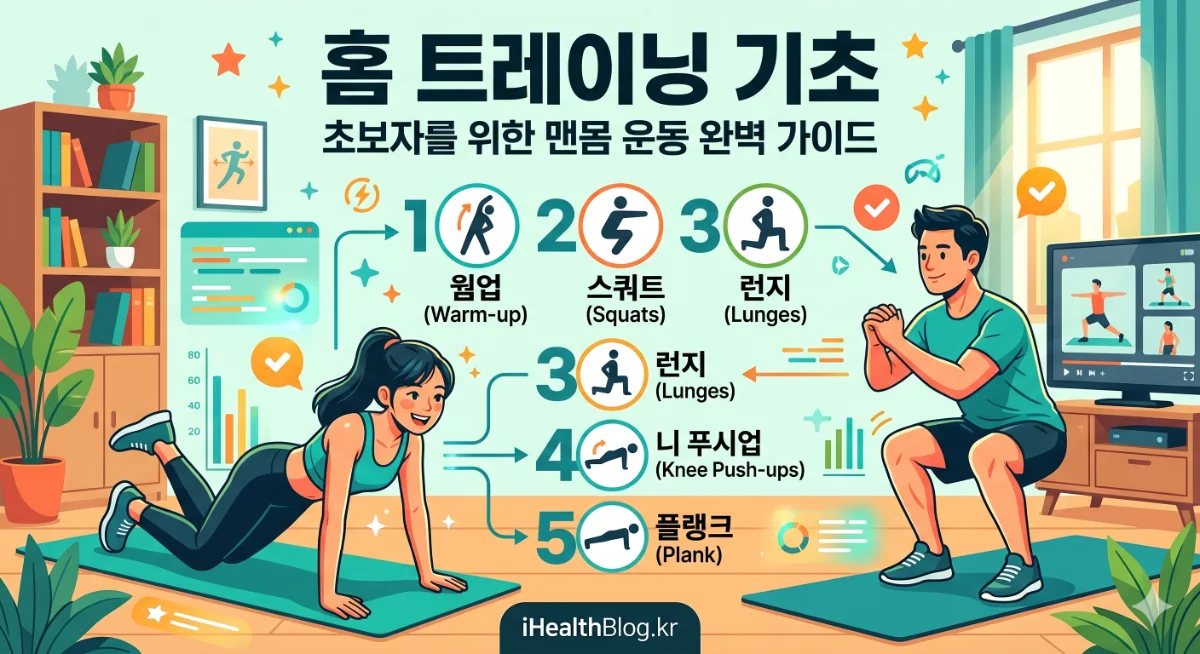
5 Basic Bodyweight Exercises for Beginners
The American College of Sports Medicine (ACSM) recommends that beginners engage in regular exercise for at least 30 minutes, three times a week. The following five exercises are the most effective for developing overall strength.
1. Push-ups
Push-ups are a compound exercise that strengthens the chest, shoulders, and triceps. According to research from Seoul National University’s Department of Sports Science, male beginners who perform push-ups three times a week for four weeks can increase upper body strength by an average of 15-20%.
Beginner Progression Steps:
- Week 1: 10 reps × 3 sets with knees on the floor
- Weeks 2-3: 15 reps × 3 sets in the same manner
- Week 4 and beyond: Standard push-ups on toes, 8-10 reps × 3 sets
Maintaining proper form is crucial. Keep your body in a straight line, and your elbows should bend to about 90 degrees.
2. Squats
Squats are an exercise that strengthens the leg and glute muscles, developing the lower body, which accounts for about 60% of total muscle mass. According to an analysis by a research team from Yonsei University in 2022, performing squats correctly can increase basal metabolic rate by 5-8%.
Correct Execution Method:
- Stand with feet shoulder-width apart
- Slowly lower yourself while keeping your back straight
- Be careful not to let your knees extend beyond your toes
- Lower yourself until your thighs are parallel to the ground
- Push back up through your heels
Beginners should start with 15 reps × 3 sets, increasing by 5 reps every two weeks.
3. Plank
The plank is a static exercise that strengthens core muscles (abdominals and lower back). Research published in the Journal of Sports Medicine in the U.S. indicates that holding a plank for just 60 seconds daily can improve abdominal strength by about 30% after eight weeks.
Starting Steps:
- Hold for 20 seconds with knees on the floor × 3 sets
- After 2 weeks: Hold for 30 seconds × 3 sets
- After 4 weeks: Hold for 30 seconds on toes × 3 sets
- After 6 weeks: Hold for 60 seconds × 3 sets
Breathing is important. Do not hold your breath; breathe steadily in and out.
4. Lunges
Lunges correct leg imbalances and strengthen each leg individually. According to statistics from the Korean Fitness Association, lunges are one of the most effective exercises for improving lower body stability.
Basic Execution Method:
- Stand and step one leg forward
- Slowly lower until the back knee nearly touches the ground
- Push back to the starting position using the front leg
- Alternate legs, doing 10 reps each × 3 sets
5. Burpees
Burpees are a full-body exercise that combines push-ups and squats, rapidly increasing heart rate and providing aerobic benefits. According to research from Stanford University’s exercise physiology department, 10 minutes of burpees can burn a similar number of calories as 30 minutes of moderate-intensity aerobic exercise.
Progression Steps:
- Beginner Level: From a squat position, place hands on the ground, jump back into a push-up position, return to squat, and stand up (5 reps × 2 sets)
- Intermediate Level: Add a push-up to the above movement (10 reps × 3 sets)
- Advanced Level: Add a jump to the above movement (15 reps × 3 sets)
Creating an Exercise Program for Beginners
An effective exercise program requires a clear structure and gradual progression. According to the exercise guidelines from the National Health Insurance Service of South Korea, strength training should be performed at least twice a week, and aerobic exercise at least three times a week.
Weekly Exercise Schedule Example
Monday (Upper Body Focus): Push-ups 3 sets, Plank 3 sets, Burpees 2 sets, 60 seconds rest
Wednesday (Lower Body Focus): Squats 3 sets, Lunges 3 sets, Plank 2 sets, 60 seconds rest
Friday (Full Body Workout): Squats 2 sets, Push-ups 2 sets, Lunges 2 sets, Plank 2 sets, Burpees 2 sets
Tuesday, Thursday: Light stretching or walking for 20-30 minutes
Saturday, Sunday: Complete rest or a walk
This program increases exercise difficulty every four weeks. Progress by increasing the number of reps by 5-10% or adding more sets every four weeks.
Common Mistakes Beginners Should Avoid
Many beginners start with excessive enthusiasm and end up quitting due to injury or exhaustion. According to research from Ajou University’s Department of Sports Medicine, about 35% of beginners stop exercising within the first two weeks. Let’s look at mistakes to avoid to prevent this.
Excessive Exercise Volume
Trying to do too much too soon is the most common mistake. Starting at a high intensity can lead to muscle soreness, fatigue, and increased risk of injury. Follow the principle of Progressive Overload. Increasing by just 5-10% each week is appropriate.
Poor Form
Poor form can reduce the effectiveness of the exercise by more than 50% and increase the risk of injury. Initially, prioritize correct form over the number of repetitions. Exercising in front of a mirror or recording yourself can be good methods to check your form.
Insufficient Rest
Muscles grow not during exercise, but during rest. Training the same muscle group every day can lead to overtraining syndrome. Beginners should allow at least 48 hours of rest between workouts for the same muscle group.
Neglecting Nutrition
Exercise alone is not enough. According to the Korean Society of Food and Nutrition, individuals engaging in strength training need to consume 1.2-2.0g of protein per kilogram of body weight. For a 70kg adult, this means consuming 84-140g of protein daily.
Tips for Maintaining Motivation and Consistency
The first three weeks are the most crucial. Research by the American Psychological Association indicates that it takes an average of 66 days for a new habit to stick. The following strategies can help.
Keep a workout log: Record your daily workouts and repetitions in a smartphone app or notebook. Visual progress boosts motivation.
Exercise at the same time: Working out at the same time every day makes it easier to form a habit. For example, set a time for 7 AM or 7 PM every day.
Set goals: Establish specific and measurable goals, such as "lose 10kg" or "30 push-ups in 2 months."
Work out with friends: Finding a workout buddy or family member makes it easier to stay consistent. Joining an online community can also be a good idea.
Use music: Upbeat music can increase workout intensity and reduce boredom. Prepare a workout playlist with a BPM of 130-150.
Expected Results After the First 4 Weeks
Beginners who exercise regularly may notice the following changes after four weeks.
Physical Changes: While there may not be noticeable weight loss (2-4kg), clothes may fit looser, and skin elasticity may improve. Since muscle is denser than fat, weight changes may be minimal.
Improved Fitness: You may feel less fatigued during daily activities and notice that you get less out of breath when climbing stairs.
Improved Mood: The endorphins released during exercise can enhance your mood and reduce stress.
Better Sleep Quality: Regular exercise improves sleep quality and increases deep sleep duration.
If you are a beginner, the first four weeks are an adaptation phase. Don’t expect drastic changes; celebrate small progress and maintain consistency. Viewing exercise from a long-term perspective is key to success.
Conclusion
Home training is an excellent starting point for beginners to establish healthy habits. You can achieve significant results with bodyweight exercises alone, without special equipment or expensive memberships.
The keys to success are as follows: First, prioritize proper form. Correct technique is more important than the number of repetitions. Second, progress gradually. Overexertion can lead to injury and burnout. Third, maintain consistency. Regular exercise three times a week is more effective than bi-weekly high-intensity workouts. Fourth, prioritize nutrition and rest. Exercise alone is insufficient; adequate protein intake and recovery are essential.
The exercises in this guide are scientifically validated for effectiveness and safety. By faithfully following the above program for the first four weeks, you can lay the foundation for both physical changes and exercise habits. If you feel apprehensive about this new beginning, remember that it’s okay not to be perfect. What matters is that today’s small efforts accumulate to create significant changes in the future. Roll out your yoga mat and start your first workout now.