Can You Do Strength Training at Home Without Dumbbells?
When many people consider starting strength training, the first thing that comes to mind is the "cost of a gym membership." In South Korea, the average monthly fee for a regular fitness center ranges from 50,000 to 150,000 won, resulting in an annual cost of 600,000 to 1,800,000 won. Additionally, purchasing a set of dumbbells requires at least 300,000 to 500,000 won.
However, there is good news. According to a 2023 study by the American College of Sports Medicine (ACSM), bodyweight resistance exercises are also very effective for increasing strength. In fact, a 12-week bodyweight training program can improve strength by 20 to 30%. In this article, we will introduce five essential strength exercises that you can practice at home without dumbbells.
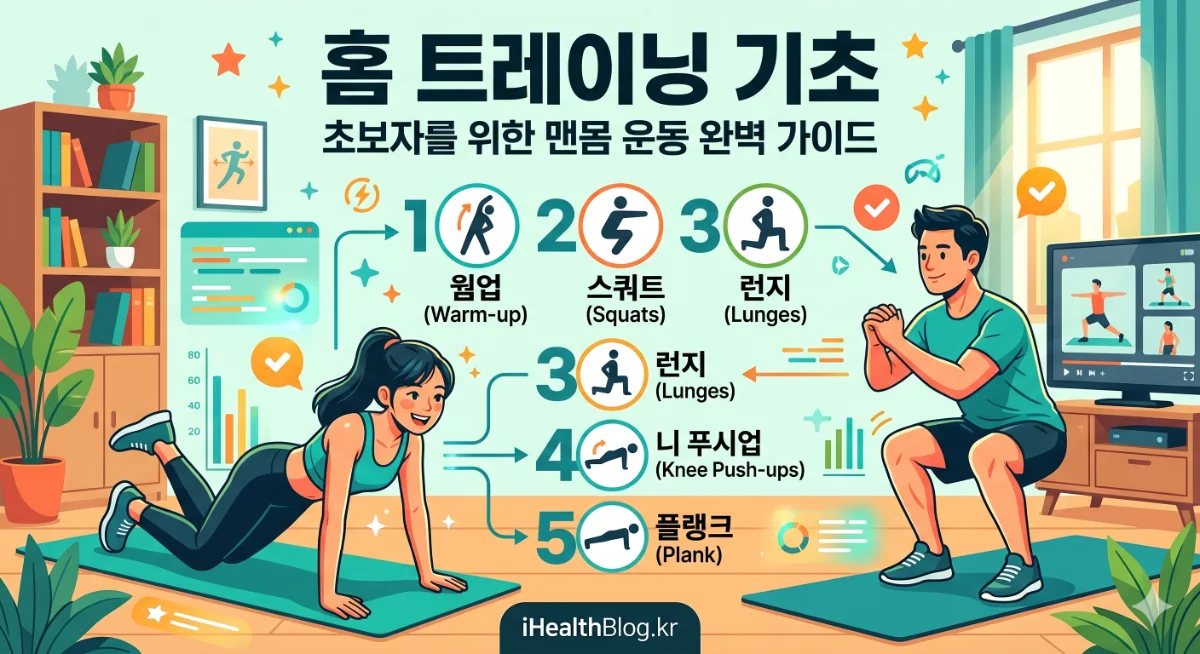
Push-Ups: The King of Upper Body Exercises
Push-ups are the most efficient upper body exercise that simultaneously trains the chest, shoulders, and triceps. Considering that the average weight of Korean men is about 75 kg, approximately 50 to 60% of that weight is loaded on the upper body during a single push-up.
Proper Push-Up Form
- Place your hands slightly wider than shoulder-width apart on the floor.
- Engage your core to maintain a straight line from head to heels.
- Lower your body until your elbows are at about a 45-degree angle from your body.
- Push back up until your arms are straight.
- Inhale as you lower your body and exhale as you push up.
Recommended Sets: 3 sets × 10-15 reps
If you are a beginner, you can start with your knees on the ground or with your hands on a desk or chair. According to a 2022 study by the research team at Seoul National University’s Department of Sports Science, push-ups performed 2 to 3 times a week resulted in an average 22% increase in upper body strength after 8 weeks.
Squats: The Foundation of Lower Body Strength
Squats engage about 70% of the muscles in the entire body. They are particularly effective for training the quadriceps, glutes, calves, and spinal stabilizing muscles, making them one of the best exercises for home workouts.
Proper Squat Execution
- Stand with your feet shoulder-width apart and toes pointed slightly outward (about 15 degrees).
- Keep your eyes looking straight ahead and your chest lifted.
- Lower your body by pushing your hips back, ensuring your knees do not extend past your toes.
- Descend until your knees are at a 90-degree angle, then rise back up.
- Inhale as you lower your body and exhale as you rise.
Recommended Sets: 3 sets × 12-20 reps
A 2023 study from University College London found that squats are effective for blood sugar control, with 3 sessions of resistance training per week totaling 75 minutes improving insulin sensitivity by 27%, which can help prevent diabetes.
Plank: An Essential Core Stabilization Exercise
The plank is an isometric exercise that stabilizes the abdomen, back, and shoulders. It places minimal stress on the joints while allowing for deep core activation.
How to Perform a Plank
- Position your elbows directly under your shoulders.
- Support your body on your toes, keeping it in a straight line.
- Engage your core to prevent your hips from sagging.
- Keep your neck in a neutral position and look straight ahead.
- Breathe steadily and slowly (do not hold your breath).
Recommended Time: 3 sets × 30-60 seconds
According to a survey by the Korean Society of Sports Science, about 65% of adults over 40 experience spinal-related pain, and regular plank exercises can strengthen spinal stabilizing muscles, potentially reducing back pain by about 30%.
Lunges: Balance and Lower Body Strength
Lunges are an exercise that trains both legs evenly while simultaneously improving balance. They allow you to strengthen the weaker leg by working one leg at a time.
Proper Lunge Form
- Bring your hands together in front of your chest or let them hang naturally at your sides.
- Step forward with one foot, taking a large step (about 60-90 cm).
- Lower your front knee until it reaches a 90-degree angle.
- Lower your back knee close to the ground.
- Push back to the starting position using the heel of your front foot.
- Alternate legs for each repetition.
Recommended Sets: 3 sets × 10-15 reps per leg
Lunges are among the higher intensity bodyweight exercises, and when performed consistently, they can develop the glutes, quadriceps, hamstrings, and calves evenly.
Push-Up Variations: Adjusting Difficulty
If standard push-ups are challenging, you can gradually build your strength through various modifications.
Push-Up Variations by Difficulty
Step 1: Wall Push-Ups
This involves pushing against a wall, where only about 40% of your body weight is loaded on your hands. It's important to focus on form and breathing at this stage.
Step 2: Desk/Chair Push-Ups
Performing push-ups with your hands on a higher surface will load about 50-60% of your body weight on your upper body. Using a standard desk (about 75 cm high) or a sofa (about 40 cm high) is effective.
Step 3: Knee Push-Ups
Doing push-ups with your knees on the ground loads about 60-70% of your body weight on your upper body. Placing a yoga mat or cushion under your knees can make this more comfortable.
Step 4: Standard Push-Ups
This is the basic form supported only by your toes, where about 65-75% of your body weight is loaded on your upper body.
Step 5: Advanced Push-Ups
You can increase difficulty by narrowing your hand position, performing with one hand, or adding explosive movements.
Creating an Effective Home Workout Program
By effectively combining the five exercises above, you can create a weekly workout program.
Weekly Strength Training Schedule
- Monday (Upper Body Focus): Push-Ups 3 sets × 10 reps, Plank 3 sets × 45 seconds, Tricep Dips 3 sets × 10 reps
- Tuesday (Lower Body Focus): Squats 3 sets × 15 reps, Lunges 3 sets × 10 reps each leg, Calf Raises 3 sets × 20 reps
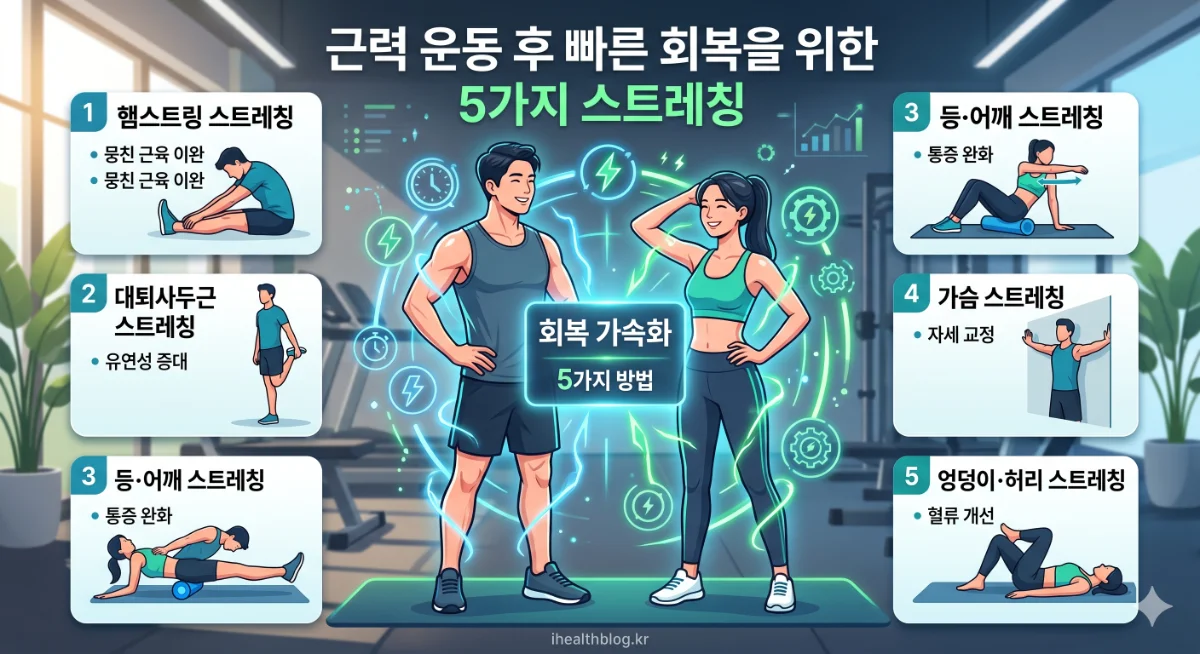
- Wednesday (Rest or Light Stretching)
- Thursday (Full Body Workout): Push-Ups 2 sets × 10 reps, Squats 2 sets × 15 reps, Plank 2 sets × 40 seconds, Lunges 2 sets × 10 reps each leg
- Friday (Core Focus): Plank 3 sets × 50 seconds, Side Plank 3 sets × 30 seconds each side, Dead Bug 3 sets × 15 reps
- Saturday (Lower Body Strength): Squats 3 sets × 15 reps, Lunges 3 sets × 12 reps each leg, Glute Bridge 3 sets × 15 reps
- Sunday (Complete Rest or Light Walk)
Research in exercise science suggests that allowing at least 48 hours of rest before repeating exercises for the same muscle group is most effective for muscle growth. Therefore, it is recommended to separate upper and lower body workouts as outlined in the schedule above.
Tips and Precautions for Home Workouts
Preparing Your Workout Space
You don't need a large space; an area of about 2m × 2m is sufficient. If you are exercising on a heated floor or hardwood, it's advisable to use a yoga mat (costing around 10,000 to 30,000 won) to prevent spinal injuries.
Pre-Workout Preparation
- Stay Hydrated: Drink small amounts of water starting 30 minutes before your workout.
- Light Warm-Up: Engage in 5-10 minutes of light stretching and aerobic exercises (like jogging in place).
- Wear Appropriate Clothing: Prepare clothes that allow for free movement and wear athletic shoes.
Precautions During Exercise
- Progress Gradually: Start with low intensity for the first 1-2 weeks to allow your body to adapt.
- Prioritize Proper Form: Correct form is more important than the number of repetitions.
- Distinguish Between Pain and Fatigue: Mild muscle fatigue is normal, but if you experience sharp pain, stop immediately.
- Consistency: To see noticeable results, maintain a routine of at least 3 times a week for over 8 weeks.
Nutritional Management
To maximize the benefits of strength training, proper nutrition is essential. According to the Korean Nutrition Society, adult men should consume about 60-70g of protein per day, while adult women should aim for 50-60g.
- Eggs: About 6g of protein per egg.
- Greek Yogurt: About 10g of protein per 100g.
- Tofu: About 15-20g of protein per block (about 300g).
- Chicken Breast: About 31g of protein per 100g.
- Legumes: About 10-15g of protein per 100g.
Expected Results from Home Workouts
With consistent exercise, you can expect the following changes:
- After 4 Weeks: Minimal physical change, but strength improves by about 10% and energy levels increase.
- After 8 Weeks: Strength increases by about 20-30%, body fat decreases by 1-2 kg, and physical appearance begins to change.
- After 12 Weeks: Muscle mass increases by about 1-2 kg, body lines become more defined, and you feel an improvement in daily activities.
- After 6 Months: Strength increases by 40-50% compared to the start, and body composition shows significant improvement.
These results may vary based on individual fitness levels, diet, and quality of sleep.
Conclusion
It is entirely possible to achieve sufficient strength training at home without a gym. With just five basic exercises—push-ups, squats, planks, and lunges—you can effectively train the major muscle groups of your body while saving on gym fees of 50,000 to 150,000 won per month, all while achieving scientifically proven results.
The key is consistency. A regular program that you can stick to is much more effective than a perfect one. Refer to the schedule and precautions provided in this article and start exercising at home today. You will be amazed at the positive changes in your body and health after 8 weeks.
If you have any pre-existing conditions, it’s advisable to consult a healthcare professional before starting an exercise program, and if you experience any injuries or pain during exercise, seek medical assistance immediately. Take the first step towards a healthy body—start now!