Things Beginners Should Know Before Starting Exercise
The most common mistake made by those who are starting to exercise for the first time is setting unrealistic plans. According to the Korean Medical Association, about 70% of beginners who start exercising give up within three months. To prevent this, a realistic and sustainable exercise plan is essential.
The World Health Organization (WHO) recommends the following weekly physical activity guidelines:
- Moderate-intensity aerobic exercise: at least 150 minutes per week
- Vigorous-intensity aerobic exercise: at least 75 minutes per week
- Strength training: at least 2 days per week (targeting major muscle groups)
For beginners, it is important to gradually reach these standards. The first two weeks are a time for the body to adapt to exercise, so it is advisable to start at a level that is about 20-30% higher than your usual activity level.
Basic Structure of a 5-Day Workout Routine
An effective weekly workout plan focuses on balancing muscle recovery and a variety of exercises. Here is a basic framework that beginners can follow:
- Monday: Aerobic exercise + Upper body strength training
- Tuesday: Lower body strength training + Stretching
- Wednesday: Rest day or light yoga
- Thursday: Aerobic exercise + Core exercises
- Friday: Full-body strength training
- Saturday: Recreational exercise (swimming, hiking, badminton, etc.)
- Sunday: Complete rest
This structure is designed to ensure that the same muscle groups are not worked consecutively, allowing for adequate recovery time while still enabling at least two strength training sessions per week.
Monday: A Balance of Aerobic Exercise and Upper Body Strength
Starting the weekly workout on Monday is a great time to begin with high motivation, so it's good to start with intense exercises. However, remember not to overdo it.
Monday Workout Structure (Total 60 minutes):
- Warm-up (5 minutes): Light stretching and dynamic stretching
- Aerobic exercise (20 minutes): Treadmill, cycling, or running
- Beginner level: 50-60% of maximum heart rate (approximately 6-8 km/h)
- Heart rate = (220 - age) × 0.5~0.6
- Upper body strength training (30 minutes):
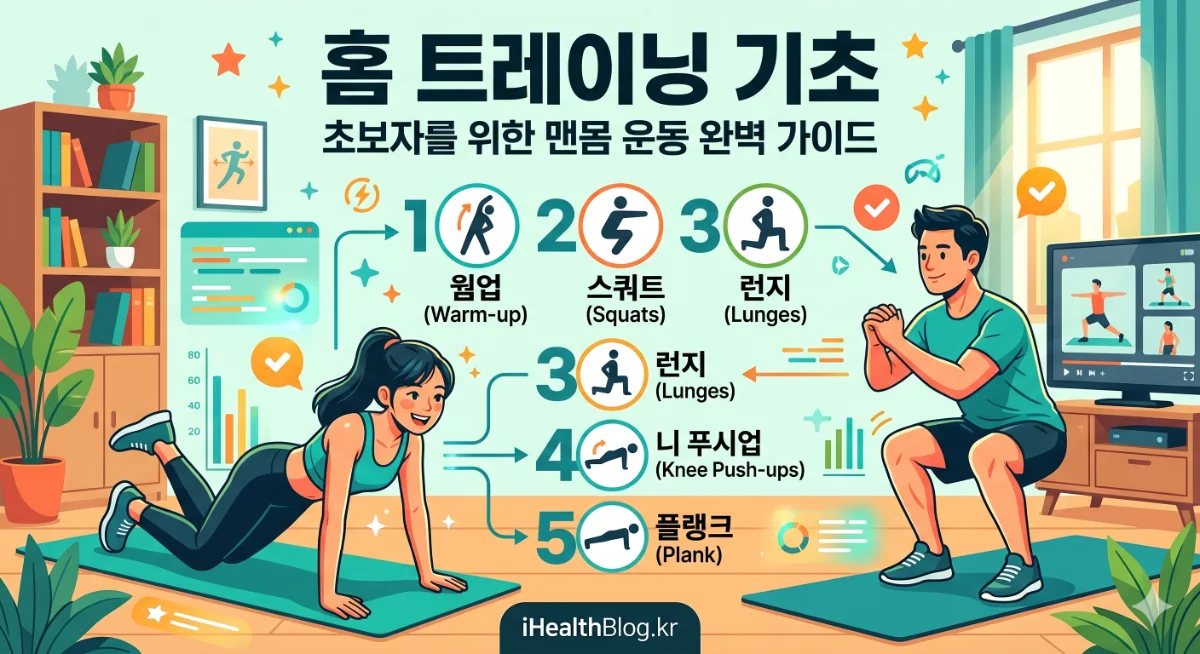
- Push-ups 3 sets × 8-12 reps
- Dumbbell rows 3 sets × 10 reps (1-2 kg dumbbells)
- Shoulder press 3 sets × 10 reps (0.5-1 kg dumbbells)
- Bicep curls 3 sets × 12 reps
- Cool down (5 minutes): Upper body stretching
Rest between sets during upper body exercises should be about 1-2 minutes. If you don't have dumbbells, you can use a water bottle (approximately 500g for a 500ml bottle).
Tuesday and Thursday: Lower Body and Core Strengthening Program
The lower body consists of the largest muscle groups in our body. According to domestic fitness experts, lower body exercises can increase basal metabolic rate by 5-10%.
Tuesday Workout Structure (Total 50 minutes):
- Warm-up (5 minutes): Dynamic stretching
- Lower body strength training (35 minutes):
- Squats 3 sets × 15 reps (body weight)
- Lunges 3 sets × 10 reps (each side)
- Hip thrusts 3 sets × 12 reps
- Side leg raises 3 sets × 15 reps
- Stretching (10 minutes): Lower body and hip stretching
Thursday Workout Structure (Total 55 minutes):
- Warm-up (5 minutes): Light aerobic exercise
- Aerobic exercise (20 minutes): Low intensity at 55-65% heart rate
- Core exercises (25 minutes):
- Plank 3 sets × 30 seconds
- Crunches 3 sets × 15 reps
- Russian twists 3 sets × 20 reps (each side)
- Leg raises 3 sets × 12 reps
- Bird-dog 3 sets × 12 reps (each side)
- Cool down (5 minutes)
Key Tip: Core exercises are crucial for posture correction and spinal health. This is especially essential for office workers who sit all day. Maintaining proper form for each exercise is more important than doing many repetitions.
Friday: Wrapping Up the Week with Full-Body Workouts
Friday is the last intense workout day of the week. Full-body strength training helps to compensate for any missed workouts during the week and prepares you for the weekend.
Friday Workout Structure (Total 60 minutes):
- Warm-up (5 minutes)
- Full-body circuit training (50 minutes) - 1-minute rest between each exercise
- Set 1: Squats (15 reps) → Push-ups (10 reps) → Deadlift alternative (kettlebell swings, 15 reps) → Plank (30 seconds) → Rest (1 minute)
- Set 2: Lunges (12 reps) → Dumbbell rows (12 reps) → Glute bridges (15 reps) → Crunches (15 reps) → Rest (1 minute)
- Set 3: Step-ups (10 reps) → Shoulder press (10 reps) → High knees (15 reps) → Russian twists (20 reps) → Rest (1 minute)
- Cool down (5 minutes): Full body stretching
Full-body circuit training is highly efficient as it elevates heart rate while simultaneously improving strength. According to research from the Korean Society of Sports Science, circuit training burns 15-20% more calories than traditional resistance training over the same duration.
Saturday: Recreational Exercise and Active Recovery
Saturday's recreational exercise is a day to reduce pressure and increase enjoyment. This is a key factor in maintaining a consistent workout routine.
Recommended Activities:
- Swimming (1 hour): Full-body workout, low joint impact, approximately 15,000-50,000 won for weekly access
- Hiking (2-3 hours): Lower body workout, aerobic exercise, free of charge
- Badminton (1.5 hours): Improves agility, aerobic exercise, facility fee around 10,000-20,000 won
- Yoga class (1 hour): Flexibility and recovery, monthly subscription service available for 50,000-100,000 won
- Cycling (1-2 hours): Aerobic exercise, free of charge (basic bike purchase cost separate)
It is most important to choose activities that you enjoy on Saturdays. Exercises that are not enjoyable will not be sustained.
Essential Exercise Guidelines for Beginners
1. Principle of Progressive Overload
If you did 10 reps in the first week, increase to 12-15 reps in weeks 2-3, and when that becomes easy, increase the weight. Sudden increases can lead to injuries.
2. Adequate Rest and Sleep
Muscle strength actually increases during rest, not during exercise. Adults need at least 7-8 hours of sleep and a minimum of 48 hours of recovery time after strength training. This is as important as the exercise itself.
3. Proper Nutritional Intake
Consume 1.2-1.6g of protein per kg of average weekly body weight. For example, a 70kg person needs to consume 84-112g of protein daily. This can be calculated with foods like eggs (6-7g), 100g of Greek yogurt (10g), and 100g of chicken breast (25g).
4. Hydration
About 15ml of fluid is needed per kg of body weight during exercise. For a 70kg person, this means about 1 liter of fluid intake during an hour of exercise.
5. Check Your Form
In the first 2-3 weeks, focus on learning the correct form with light weights. You can refer to YouTube videos on 'beginner proper form' for each exercise, or if possible, investing in 1-2 personal training sessions (around 50,000-80,000 won) to learn proper form is a good investment.
How to Keep Track of Workouts and Maintain Motivation
Research shows that those who keep a workout log are 35% more likely to stay consistent.
Recommended Tracking Methods:
- Smartphone note app: Record sets, reps, and weights for each exercise
- Free apps: 'Gymit', 'RepCount', etc.
- Smartwatch: Automatically records heart rate and calories burned
- Calendar check: Provides visual achievement for motivation
Setting goals is also important. For example, set specific and measurable goals like "do 30 push-ups in a row within 3 months" or "lose 5kg in 3 months."
Managing Initial Fatigue and Muscle Soreness
Muscle soreness typically appears 2-3 days after starting exercise, known as delayed onset muscle soreness (DOMS), which is a normal occurrence. It generally subsides within 3-5 days.
Muscle Soreness Management Methods:
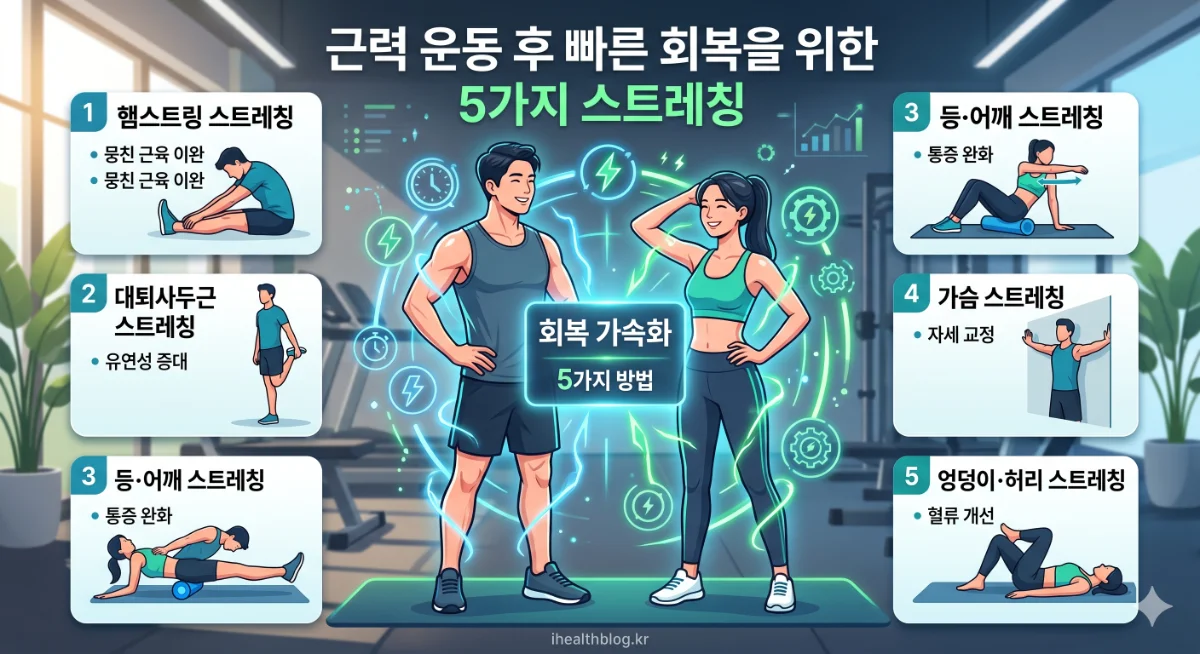
- Stretching: 5-10 minutes of static stretching after exercise
- Heat therapy: Warm showers or saunas (around 8,000-15,000 won)
- Massage: Foam rollers (around 15,000-40,000 won) or regular massages
- Adequate rest: The most important recovery method
- Proper nutrition: Increase protein intake
Even if you have muscle soreness, it's okay to continue exercising other body parts. For example, if your legs are sore, you can still do upper body workouts.
Conclusion
Creating a weekly workout routine may seem complicated, but anyone can do it by following basic principles. The perfect routine for beginners can be summarized as follows:
- Monday: Aerobic exercise (20 minutes) + Upper body strength (30 minutes)
- Tuesday: Lower body strength training (35 minutes) + Stretching (10 minutes)
- Wednesday: Rest or light yoga
- Thursday: Light aerobic exercise (20 minutes) + Core exercises (25 minutes)
- Friday: Full-body circuit training (50 minutes)
- Saturday: Recreational exercise (swimming, hiking, badminton, etc.)
- Sunday: Complete rest
This routine meets the WHO recommended guidelines while balancing strength training, aerobic exercise, and recovery. Start at a 70% intensity level during the first two weeks as an adaptation period, and gradually increase from week three.
The most important thing is consistency. Sticking to an 80% level plan for a year will lead to much greater changes than executing a perfect plan for just one month. If you make exercise a part of your life and gradually improve, you will definitely notice significant changes after three months.
If starting seems difficult, it's perfectly fine to begin with just three days of exercise a week. What matters is to start and continue. We support your fitness journey!